HomeApplicationsGaskets
Precisely laser-cut flat gaskets from rubber and EPDM for mechanical engineering and apparatus engineering — CAESS Laser Switzerland.
Applications · Gaskets

Laser-cut gaskets — custom flat gaskets, tool-free and precise.

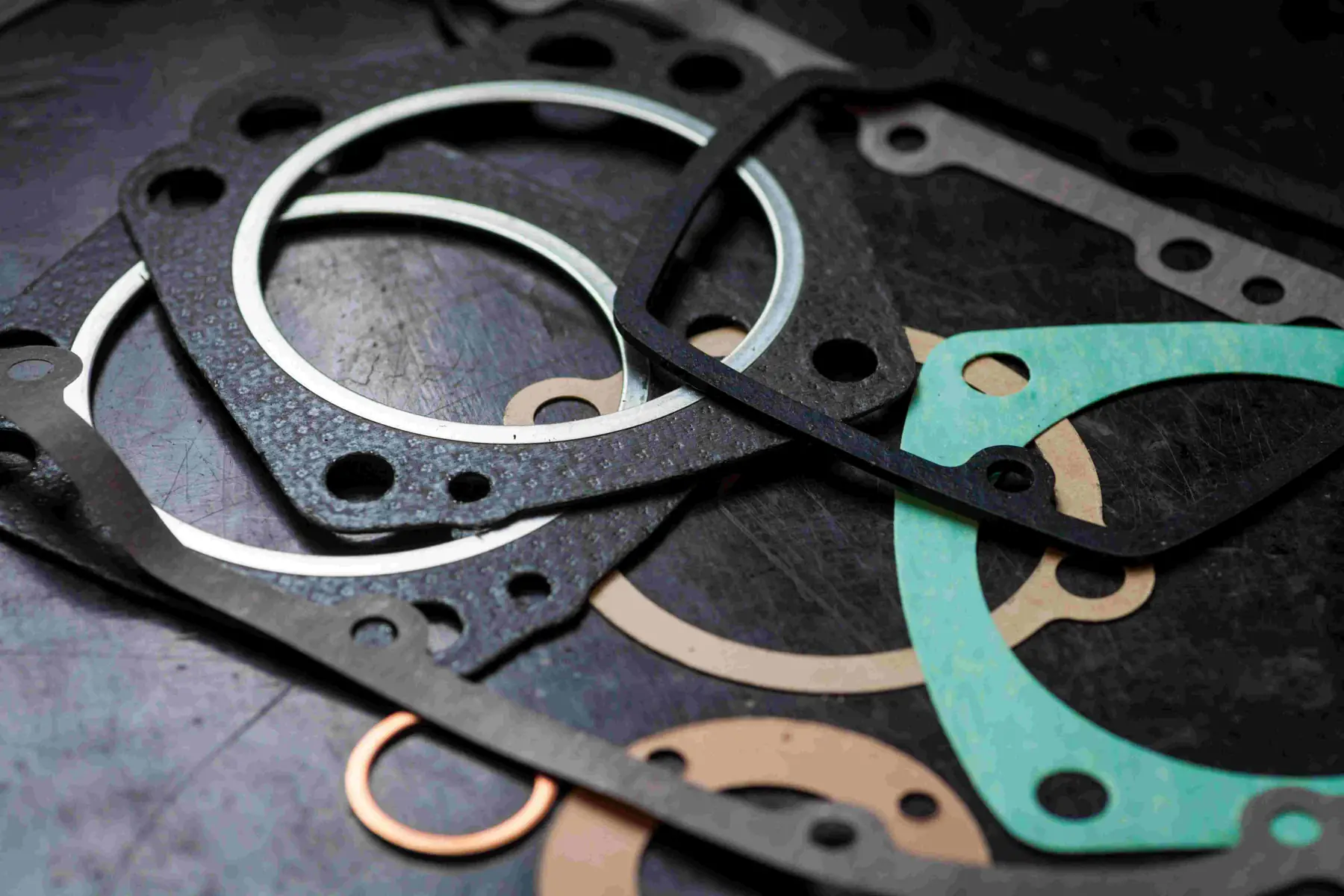
For mechanical engineering, apparatus engineering and technical procurement, the focus is on custom flat gaskets that can be produced economically without stamping tools, without long lead times and from a single piece. CAESS Laser cuts gaskets from rubber, EPDM, silicone, neoprene, cork and foam precisely from CAD data, drawings or sample gaskets — reproducible up to recurring series.

Gaskets that fit — without the detour via stamping tools and minimum quantities

The key is the difference between a gasket from a stamping tool and a tool-free laser cut — in lead time, flexibility and economy for small quantities. Especially for replacement gaskets, prototypes and special geometries, laser cutting is the direct alternative to classic stamping: no tooling, no minimum quantity, no long waiting times.

Material suitability

Rubber, EPDM, silicone, neoprene, cork and foam precisely cut

The CO2 laser is suitable for a wide range of soft and semi-hard gasket materials. Tight inner radii, fine webs and complex outer contours can be realised without additional effort because the laser beam works contactlessly and exerts no compression forces on the material.

  • Rubber (NBR), EPDM, silicone, neoprene (CR)
  • Cork, cellular rubber, foam and sponge rubber
  • Klingersil-type fibre gaskets clarifiable on request

Data basis

CAD data, drawing or sample gasket as a starting point

CAESS Laser works with whatever is available: vector data is transferred directly, dimensioned sketches are digitised, and existing sample gaskets can be sent or measured and taken as a cutting template. Cutting data is archived for recurring orders.

  • DXF, AI, PDF (vector curves) directly processable
  • Dimensioned sketch or sample gasket as starting point possible
  • Archived cutting data for reorders

Series capability

From individual piece and replacement part to repeatable small series

Machine revisions, prototype runs and short-notice replacement procurement have one thing in common: the required quantity is small but the deadline is fixed. Since no tooling costs are incurred with laser cutting, individual pieces are just as economically calculable as a small series.

  • Individual pieces and replacement gaskets without additional costs
  • Small series with reproducible cutting quality
  • Reorders based on archived cutting data

Kleinserien

Laufende Fertigung für wiederkehrende Dichtungsbedarfe

Für Kleinserien und wiederkehrende Bedarfe bietet CAESS Laser eine zuverlässige Losfertigungslogik: Daten einmalig einrichten, dann auf Abruf produzieren — mit konstantem Ergebnis und kurzer Lieferzeit.

  • Losfertigungen ab 5 Stück
  • wiederkehrende Abrufaufträge
  • konstante Qualität ohne Werkzeugverschleiss

Geometrie

Komplexe Formen ohne Aufpreis

Enge Radien, Innenausschnitte, Langlöcher, Kombinationskonturen — beim Laserschneiden kostet Komplexität keine Zusatzgebühr. Geometrie und Werkzeugfreiheit machen den Unterschied zum Stanzen.

  • beliebig komplexe Aussenkontur
  • Innenausschnitte und Durchgangsbohrungen
  • Langlöcher und Kombinationsformen

Abstimmung

Material, Toleranz und Funktion früh klären

Für gute Dichtungszuschnitte müssen Materialwahl, Stärke, Toleranzanforderungen und Einsatzbereich vorab geklärt sein. CAESS Laser berät und gibt auf Anfrage Materialempfehlungen.

  • Materialberatung auf Anfrage
  • Musterteile vor Serienstart möglich
  • Offerte in 1–2 Werktagen

What matters technically in this application

Tool-free production as a genuine cost advantage

With stamping technology, tooling costs arise that only amortise from a certain quantity. Laser cutting has no set-up costs in this sense — any geometry can be executed directly from the file. For special geometries, individual parts and samples this is a direct economic advantage.

Contactless cutting protects the material

Soft gasket materials are sensitive to mechanical pressure. The laser works without contact and exerts no compression forces — the result is a clean cut edge without material deformation, particularly relevant for soft silicones, foams and cellular rubber.

Compatible with procurement and development

Gasket cuts at CAESS Laser are directly compatible with existing development and procurement processes: DXF data from CAD systems is transferred, tolerance requirements are compared in advance, and the process from enquiry to sample is short and direct.

Wie unterscheidet sich CO₂-Laserschneiden vom Stanzen bei Dichtungen?

Stanzen braucht ein Werkzeug pro Kontur — das kostet Zeit und Geld in der Herstellung. CO₂-Laser arbeitet werkzeuglos: jede Geometrie ist sofort schneidbar. Stanzwerkzeuge lohnen sich bei sehr grossen Serien. Für Prototypen, Muster und Kleinserien ist CO₂-Laser günstiger, flexibler und schneller.

Können komplexe Dichtungsgeometrien gelasert werden?

Ja. CO₂-Laser hat keine Einschränkungen bei der Formkomplexität. Enge Radien, Innenausschnitte, Langlöcher und Kombinationskonturen sind kein Problem. Geometrieänderungen kosten nichts Zusätzliches — einfach Datei anpassen und neu schneiden.

Wie dauerhaft sind lasergeschnittene Dichtungen?

Die Dauerhaftigkeit hängt vom Material ab, nicht vom Schneideverfahren. CO₂-Laserschnitte verändern die Materialeigenschaften am Schnittrand minimal. Bei EPDM und Silikon bleibt die Elastizität vollständig erhalten. Bei Schaumstoffen kann die Schnittkante leicht komprimiert sein — bei funktionalen Dichtungen in der Regel ohne Auswirkung auf die Dichtwirkung.

Welche Dateiformate werden für Dichtungszuschnitte benötigt?

Für Dichtungszuschnitte benötigt CAESS Laser Vektordateien im Format DXF, AI, SVG oder PDF. Konturen werden als Haarlinien (0,01 mm Strichstärke) angelegt. Massblatts als PDF oder DXF sind ebenfalls akzeptiert. Schriften müssen in Pfade umgewandelt sein. Bei Fragen zur Datenvorbereitung hilft CAESS Laser vorab.

Kann ich eigenes Dichtungsmaterial zur Bearbeitung anliefern?

Ja. Kunden können eigenes Material anliefern oder einsenden. Eine Vorabklärung der Materialeignung für den CO₂-Laser ist empfehlenswert. CAESS Laser prüft die Verarbeitbarkeit und gibt Rückmeldung, bevor der Auftrag gestartet wird. Bei Materialien mit unbekannter Zusammensetzung ist ein Mustertest sinnvoll.

Frequently asked questions

Which gasket materials can be cut with the CO2 laser?

CAESS Laser cuts flat gaskets from rubber (NBR), EPDM, silicone, neoprene (CR), cork, cellular rubber and suitable foams. Metal and PTFE are not suitable for the CO2 laser. For uncertain materials, we clarify suitability in advance.

Can I send an existing gasket as a sample without CAD data?

Yes. An existing gasket can be sent as a sample or measured. We create the required cutting data from it. A dimensioned sketch is also sufficient for a first draft.

Is there a minimum quantity for gasket cuts?

No. CAESS Laser works without minimum quantities — from individual pieces to small series. This is particularly relevant for replacement gaskets, prototypes and machine revisions where small quantities are needed at short notice.

Which file formats are needed for gasket cutting?

Vector data in DXF, AI or PDF (outlines, no text) is ideal. Alternatively, a dimensioned sketch or an existing sample gasket for digitisation is sufficient.

How precise is laser cutting for gaskets?

The typical cutting tolerance is ±0.1 mm. This is sufficiently precise for gasket applications with tight fits. For critical tolerance requirements, we clarify this in advance based on the drawing.

How much does a custom individual gasket cost?

The price depends on material, contour complexity and quantity. Since no tooling costs arise, even individual pieces can be produced economically. An enquiry with a sketch or DXF file is sufficient for an initial assessment.

Request gasket

Let us align material, contour and quantity for your gasket cut.

If drawings, DXF data, a sample gasket or simply the dimensions of the required geometry are already available, feasibility and the fastest path to the cut can usually be assessed immediately. Enquiries are typically answered within 24 hours.