Precision
Clear geometries without tooling costs
Especially with changing contours, prototypes or smaller series, CO2 laser cutting is economical because no conventional tooling costs arise.
- Sample parts
- Small series
- Variable contours
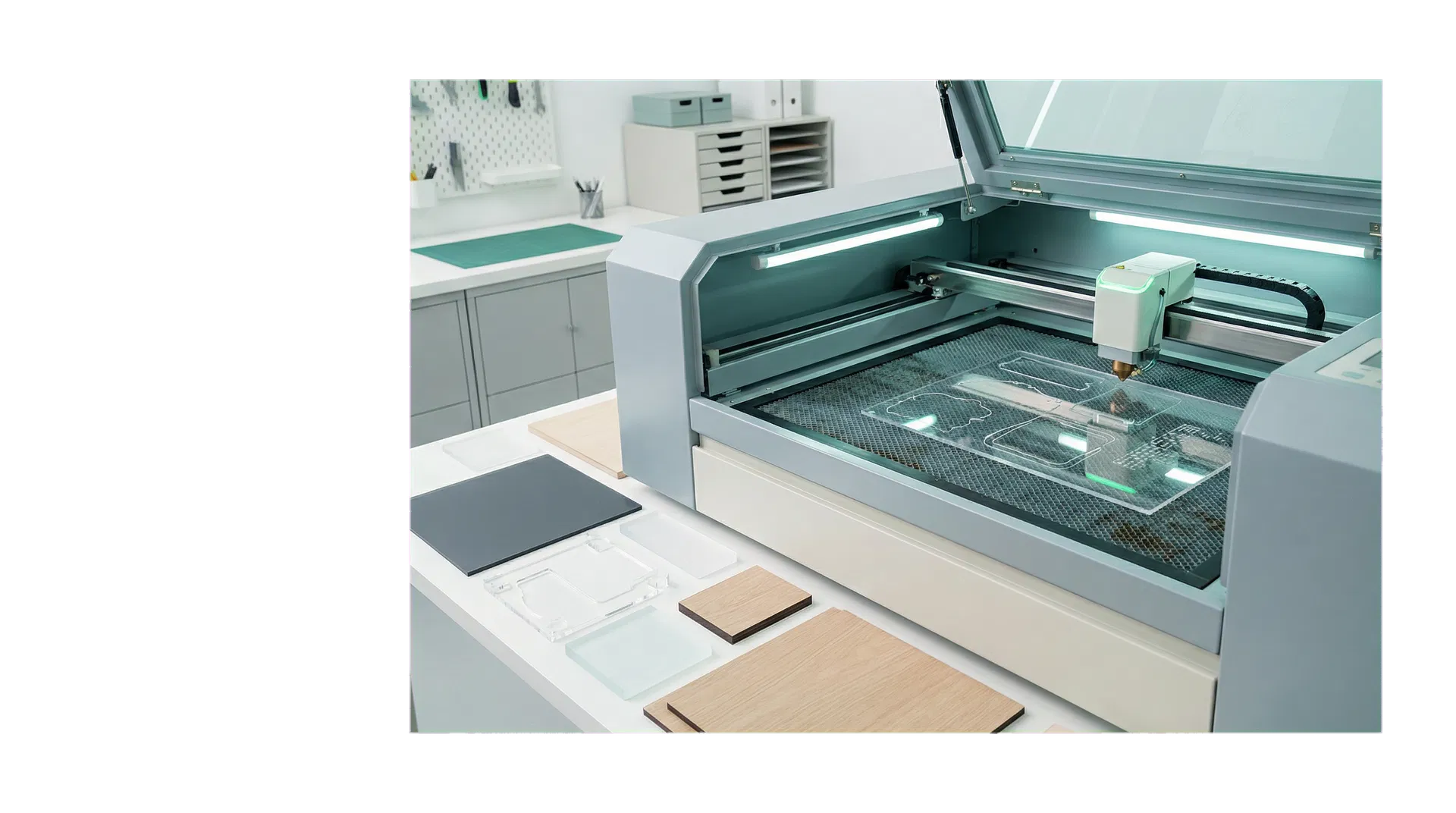
Laser cutting leads directly into the core process for cuts, functional parts and visible workpieces. The focus is on the benefit for acrylic, wood and suitable plastics.
CO2 laser cutting is suitable for precisely fitting contours, cut-outs and internal geometries in acrylic, wood-based materials and suitable plastics. Typical results are front panels, signs, inlays, covers, sample parts and custom cuts with clean edge quality.
Precision
Especially with changing contours, prototypes or smaller series, CO2 laser cutting is economical because no conventional tooling costs arise.
Materials
CAESS Laser focuses on non-metallic materials where clean cut edges, precision and good visual quality are relevant.
Applications
Typical application areas range from panels, signs and inlays to custom cuts in technical environments.
Manufacturing
When data, material and quantity are clearly described, the cut can be efficiently prepared and cleanly repeated.
Cut-outs, hole patterns and contours can be precisely executed when components need to fit cleanly and look well-made.
Tool-free cuts are particularly useful when geometries need to be tested, variants compared or small quantities required at short notice.
Clean edges and clear contours are advantageous when the workpiece should not only be functional but also look visibly premium.
Material data
These figures come from the same database as our material check. Where something is not possible, it says so here and not only in the quote.
| Material | Cutting | Engraving | Marking | What this means in practice |
|---|---|---|---|---|
| Acrylic GS (cast) | yes | yes | yes | The laser cutting classic: crystal-clear polished cut edges and brilliant deep engraving. Cast acrylic engraves milky-white — ideal for lettering. |
| Acrylic XT (extruded) | yes | conditional | yes | Cuts excellently with smooth edges and is cheaper than GS. However, engravings remain grey-transparent rather than white — first choice for pure cutting jobs. |
| PETG | conditional | conditional | conditional | Cuttable up to approx. 3 mm, but edges are not crystal-clear like acrylic and may melt slightly. For visual parts we recommend acrylic. Alternative: Acrylic GS or XT. |
| MDF | yes | yes | yes | Cost-effective, dimensionally stable and precisely cuttable. The cut edge turns dark brown — a popular contrast effect. Heavy smoke is captured by our extraction system. |
| Plywood (birch, poplar) | yes | yes | yes | The standard material for maker and model building. Birch gives light surfaces with fine grain, poplar is lighter and cuts faster. Up to approx. 12 mm. |
| Solid wood (oak, beech, maple …) | conditional | yes | yes | Engravings on solid wood are first class — high-quality, dark burn engraving. Cutting is possible up to approx. 8–10 mm; resin-rich softwoods tend to leave burn marks on the edge. |
| Cardboard / Corrugated board | yes | conditional | yes | Perfect for packaging prototypes, architectural models and displays. Clean edges without pressure marks — a clear advantage over knife cutting. |
| Paper | yes | no | conditional | Most filigree cuts for invitations, paper art and laser-cut cards — details impossible with the plotter. |
| Leather (vegetable tanned) | yes | yes | yes | Vegetable-tanned leather cuts and engraves excellently — labels, key fobs, personalizations with a premium burn look. |
| Felt (wool) | yes | conditional | conditional | Wool felt cuts with clean, firm edges — ideal for bags, cases and coasters. |
| Cork | yes | yes | yes | Cuts and engraves excellently — coasters, notice boards, packaging inserts. Natural cork and pressed cork are both suitable. |
| Polyester film (Mylar) | yes | no | conditional | Ideal for paint and spray stencils: cuts cleanly with sealed edges. Thin thicknesses up to approx. 0.5 mm. |
| Craft foam rubber | conditional | no | no | Craft foam rubber may contain PVC — no processing without material proof. EVA-based foam rubber is unproblematic, PVC-based is strictly prohibited. When in doubt we use verified EVA foam. Alternative: EVA foam with data sheet. |
| PVC rigid foam (Forex, Kömatex) | no | no | no | NEVER laser: Forex is made of PVC — laser cutting produces chlorine gas and hydrochloric acid. Popular in trade fair and shop fitting, but off-limits for the laser. We cut or mill Forex on request using alternative processes. Alternative: Acrylic, MDF or Dibond (engraving). |
| PVC (hard and soft PVC) | no | no | no | NEVER laser: PVC releases chlorine gas and hydrochloric acid when heated — highly toxic and destroys the laser machine through corrosion. The most dangerous material in laser processing. Also applies to all PVC-containing products such as vinyl films, records or PVC faux leather. Alternative: Acrylic, PETG or polyester films. |
| Bare metals (Alu, Brass, Copper, Steel) | no | no | no | Bare metals reflect the CO2 wavelength and can neither be cut nor engraved. For metal engravings and cutting, we work with partners or advise you on fibre laser solutions. Alternative: Anodised aluminium or marking via Cermark. |
CO₂ laser processes acrylic (PMMA), wood and wood-based materials (MDF, plywood), technical plastics (POM, PE, PP), foams, cardboard and textiles. Metals cannot be cut with CO₂ laser.
Typical cutting tolerance ±0.1 mm. For precision-critical parts a test cut is recommended.
The maximum work area is 800 × 500 mm. Larger parts can be manufactured in segments on request.
DXF, AI, SVG and PDF (vector curves). Cut lines as hairlines (0.01 mm). Fonts converted to paths.
No. CO₂ laser is for non-metallic materials. Metals reflect the CO₂ laser wavelength.
CO₂ laser works contactlessly. CNC milling is better for thick materials and metals. Laser cutting is more economical for complex contours in thin to medium thicknesses.
Acrylic: transparent and polished, no post-processing. Wood: slightly browned. Plastic: sharp and clean.
Standard enquiries answered within 1 working day. For small series within 2 working days.
Request cut
Send material, format and quantity — CAESS Laser checks how the CO2 laser cut can be cleanly and economically implemented.
Related Pages