Laser cutting textiles for patterns, precise cuts and creative material development.
Textiles are primarily relevant in the CO2 laser environment when patterns, contours and repeatable cuts need to be cleanly executed. The focus is on design, development and prototypical applications where fabrics, delicate patterns or functional cuts play a role.
Where textiles create genuine added value in the CO2 laser process
Textiles are particularly relevant where conventional cuts, plotters or manual work reach their limits. This applies to delicate patterns, recurring contours, stencils or creative material developments with clear geometry.
Design
For textile patterns, surfaces and creative series with clear contours
Laser-cut textiles can be used in fashion, interiors or product development when structure, repetition and precise form are part of the concept.
Pattern surfaces
Surface development
Small creative series
Cutting
For defined fabric pieces, stencils and reproducible elements
Where recurring textile contours are needed, laser cutting can help provide shapes cleanly and uniformly.
Fabric cuts
Stencils
Reproducible geometry
Prototyping
For development, testing and fast material trials
Especially in early project phases, it is helpful to quickly test textile ideas as real parts or samples rather than just discussing sketches or material samples.
Test patterns
Material trials
Development work
Clarification
Textiles always require a check of material behaviour and purpose
Depending on weave, coating and desired edge, suitability differs considerably. This technical check therefore belongs openly in project clarification.
Check weave type
Assess edge appearance
Test feasibility before series
Typical textile applications in everyday projects
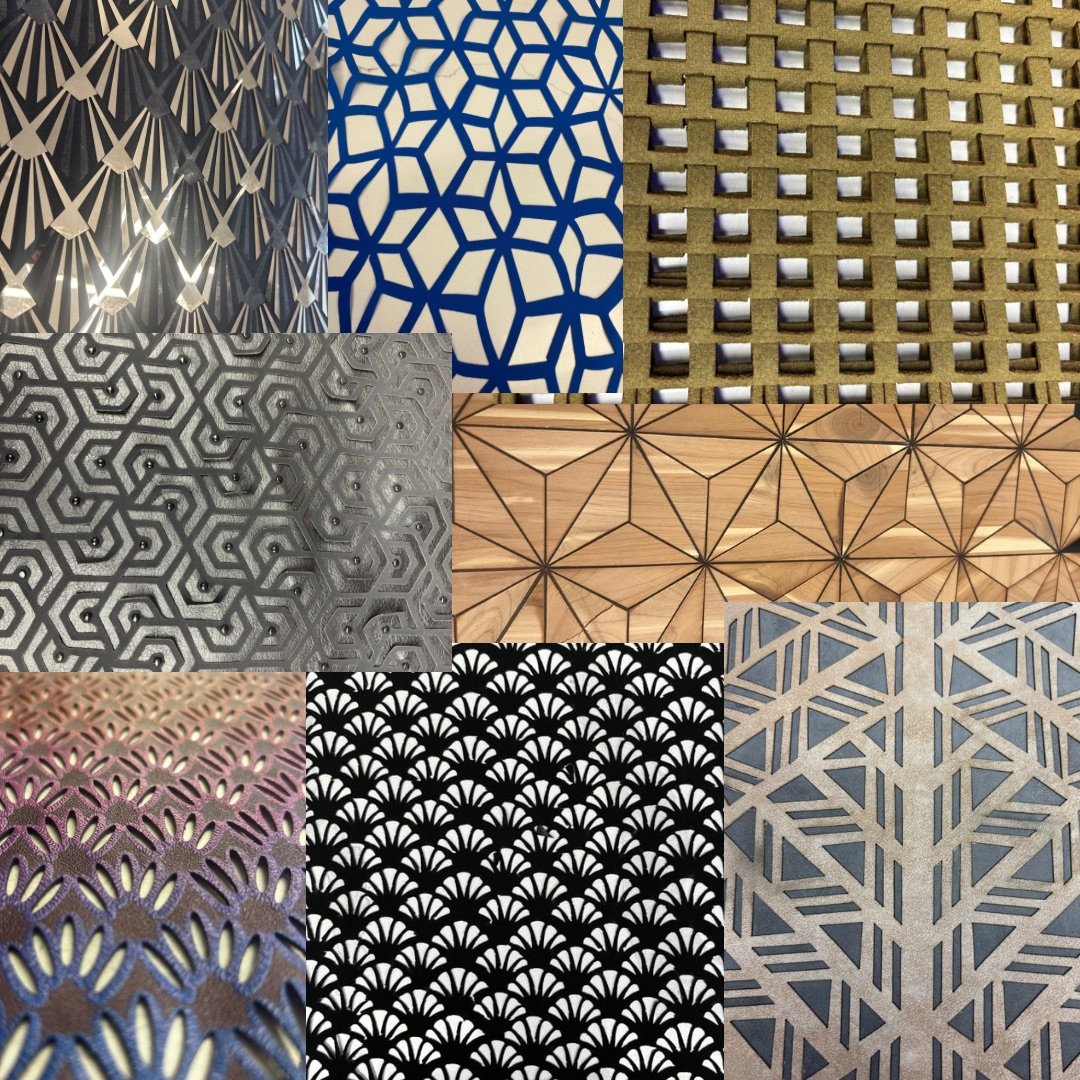
Patterns and surface development
For design, interiors and creative series when textile structures, perforation patterns or recurring forms need to be tested as real samples.
Stencils and cuts
Suitable for defined fabric pieces and reproducible contours when shapes need to be provided cleanly and uniformly.
Prototypes and material tests
Useful for early project phases when textile ideas, fabric behaviour and edge effect need to be tested practically first.
Technical specifications textiles and felt
CO2 laser cuts synthetics, polyester, felt, faux leather and coated fabrics. Cut edge sealed by melting for synthetic fibres – no fraying. Natural fibres (cotton, wool): edge quality material-dependent, slight singeing possible. Typical thickness 0.5–5 mm. Engraving possible on suitable textiles (e.g. felt, faux leather). The machine (Trotec Speedy 360, 120 W) positions to ±0.015 mm, work area 813 × 508 mm; with textiles, part accuracy depends mainly on how much the fabric stretches. Addressable accuracy 5 µm.
Material data
Cutting, engraving, marking: what works and what does not
These figures come from the same database as our material check. Where something is not possible, it says so here and not only in the quote.
Material
Cutting
Engraving
Marking
What this means in practice
Leather (vegetable tanned)
yes
yes
yes
Vegetable-tanned leather cuts and engraves excellently — labels, key fobs, personalizations with a premium burn look.
Leather (chrome tanned)
conditional
conditional
conditional
Chrome-tanned leather can release problematic chromium compounds when laser processed — processing only after clarification of the tanning method. The majority of commercially available leather is chrome tanned. If the tanning type is unclear, we recommend vegetable-tanned leather. Alternative: Vegetable-tanned leather.
Faux leather
conditional
conditional
conditional
Only PVC-free PU faux leather is laserable. PVC-based faux leather releases chlorine gas and is strictly prohibited. The data sheet is decisive: PU base yes, PVC base never. Without proof we do not process faux leather. Alternative: Genuine vegetable-tanned leather.
Felt (wool)
yes
conditional
conditional
Wool felt cuts with clean, firm edges — ideal for bags, cases and coasters.
Felt (polyester/synthetic)
yes
no
no
Cuttable — the edges fuse slightly and therefore do not fray. For a high-quality look, wool felt is the better choice.
Cotton / Linen
yes
conditional
conditional
Natural textiles cut precisely without warping. On denim, engravings (bleach effect) are even possible.
Polyester textiles
yes
no
no
The laser seals the cut edges during cutting — no fraying. Standard process in textile manufacturing.